Introduction |
This handbook was created to help with the proper development of the D0 document, the first step in creating the Final Project (FP). Here you will find the information necessary to complete the required fields of the D0, as well as some examples to facilitate your understanding.
Initial considerations |
The following are some important considerations to be taken into account when developing the document: Do not use long capital letters, i.e., always use the sentence format like this one. Writing in sustained capital letters is considered a sign of discourtesy and is difficult for many to read, which in computer language it is interpreted as a virtual scream.
Item 1: Name of study program |
This information is essential when analyzing the relevance of the final project topic proposal with the study program in which the student is enrolled. It is important to highlight the specialty/option if the program studied includes it. If you have questions about the correct name of the syllabus, consult the PANAL as indicated in the figure below:
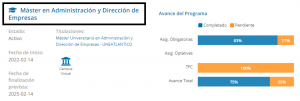
Some double degree programs may have different names for each university. If applicable, select only one of them and complete the field with the name of the study program.
Item 2: Student first and last name |
In this section, write your full name, presenting all first and last names, without using abbreviations.
Item 3: Defining the FP subject |
- Relationship to the program: If the topic submitted is not directly related to the syllabus, the proposal will be rejected.
- Affinity/identity with the subject: It is important that the selected topic be interesting and to the author’s liking, otherwise it becomes difficult to produce.
- Experience with the topic: it is best for the student to have some experience in the topic. Perhaps, try to find a topic that is part of your work routine to obtain the necessary data. It is very difficult to complete a job in which you have no experience, even if it is of interest.
- Bibliographic support: as in all academic work, it is essential to rely on the literature to provide the necessary theoretical and methodological support. It is not impossible to work on topics not often discussed in the literature, but the work becomes much more complicated.
Below are some websites for searching information. You are suggested to go to the specific ones for each field of knowledge:
- EBSCO: https://www.ebsco.com/e/es-es
- LILACS: https://lilacs.bvsalud.org/es/
- Directory of Open Access Journals: https://doaj.org/
- SciELO: https://www.scielo.org/php/index.php
- AMLC Journal Network: https://www.redalyc.org/
- ScienceDirect: https://www.sciencedirect.com/
- Elsevier: https://www.elsevier.com/advanced-search
- Dialnet: https://dialnet.unirioja.es/
- Google Scholar: https://scholar.google.es/
- PubMed: https://www.ncbi.nlm.nih.gov/pubmed
Item 4: Choosing the type of Final Project (FP) |
Developing a Final Project (FP) involves implementing what has been learned. This may be achieved through two types of approaches: FP’s with a professional approach: it is the practical application of knowledge with the objective of solving a problem or taking advantage of an opportunity. The Theoretical Framework is not so relevant in this type of project, although there is a section on conceptual references. The classic methodology is: diagnosis of the situation and design of the proposed solution to the problem, though there may be others. Typical projects have to do with improvement interventions in specific places and situations, where a well-structured and well-founded intervention is evident.
Remember that you can ask questions and raise your concerns through the Panal.